Dubois Review of American Negro Slavery Ulrich Phillips
Westward.East.B. Du Bois (1868–1963)
From W.Due east.B. Du Bois: Blackness Reconstruction
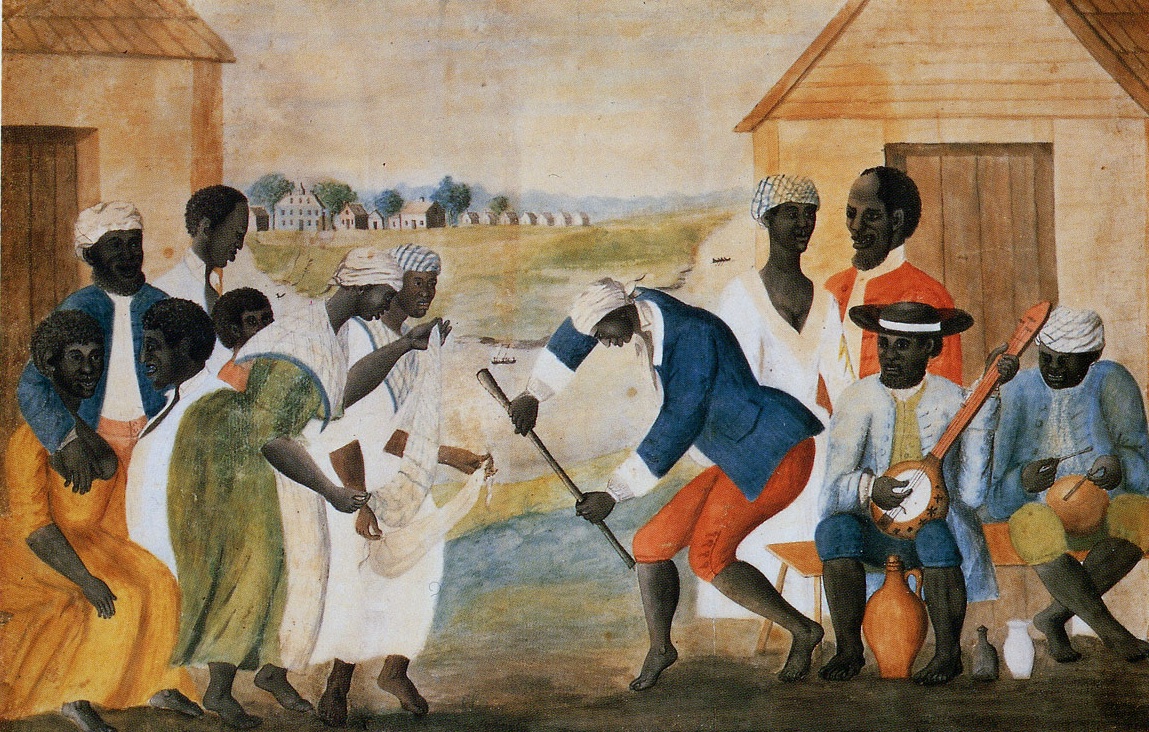 |
| "The Sometime Plantation," c. 1780s, artist unknown. Wikimedia Eatables. Virginia: History, Government, Geography, the statewide history textbook for center schools from 1957 to 1970, reprinted this slice of folk art with the caption, "When the solar day'due south work was over, the plantation Negroes enjoyed themselves." The accompanying text read, "The amusements of the adult slaves were very much similar the amusements of the masters. The white people danced to the music of fiddles in ballrooms lighted by many candles. And the Negroes in the nearby slave quarters danced by the light of pine flares to the twang of the banjoes." |
A few years ago, the historians Blain Roberts and Ethan J. Kytle wrote in The New York Times about a disconcerting resurgence among prominent Americans of the belief that slavery was a largely benign institution, one of bonhomie between plantation owners and the people they enslaved. This "romanticized interpretation of slavery [is] indebted to a volume published 100 years ago," the authors point out. "In the bound of 1918, the historian Ulrich Bonnell Phillips published his seminal study, American Negro Slavery, which framed the institution equally a benevolent labor agreement betwixt indulgent masters and happy slaves. No other book, no monument, no flick—relieve, maybe, for Gone with the Wind, itself beholden to Phillips's work—has been more influential in shaping how many Americans have viewed slavery."
When it beginning appeared, Phillips's volume was widely praised by white historians and critics, merely information technology was excoriated past African American scholars—chief among them W.E.B. Du Bois, who pulled few punches in a review published by the genteelly academic American Political Science Review:
[Phillips] has made wide utilize of southern newspapers and pamphlets and some manuscript materials, but had done petty with whatsoever Negro sources, most of which he regards as "of dubious value." . . . This intrigues the reader, for a history of slavery would ordinarily deal largely with slaves and their bespeak of view, while this book deals chiefly with the economics of slaveholders and is without exception from their betoken of view. . . .Life among Negro slaves "promoted, and wellnigh necessitated the blending of foresight and firmness with kindliness and patience." In fact the slave system was "analogous in kind and in result to the domestication of the beasts of the held." With such masters, Mr. Phillips finds the treatment of slaves on the whole excellent. He notes the "interest of the master in the future of his workers." The surviving vestiges of slave quarters prove how comfortably they were housed. . . .
It is a defense of American slavery—a defence of an institution which was at all-time a error and at worst a law-breaking—made in a day when we demand sharp and implacable judgment against collective wrongdoing by cultured and courteous men.
More recently, John David Smith, an expert on Phillips and his influence on historians, notes that "American Negro Slavery independent a virtual catalog of what even in Phillips'south solar day must have been considered derogatory remarks concerning blacks. Insensitive to Negroes equally humans, he portrayed them equally 'impulsive and inconstant, sociable and dotty, voluble, dilatory, and negligent, simply robust, amiable, obedient and contented.'"
Built-in and raised in Georgia, Phillips received his doctorate at Columbia University in 1902. He was ane of numerous young men who studied nineteenth-century American history under William Archibald Dunning. "Southern graduate students similar Phillips establish Dunning's seminar fraternal to their social philosophies and racial attitudes," notes Smith. In the same fashion that the "Dunning School" warped Americans' views of the Reconstruction era, and then too would the "Phillips Schoolhouse" recast public stance on the realities of slavery. Equally the historian John Blassingame acknowledged six years after he published his influential book, The Slave Community (1972), "The ghost of U. B. Phillips haunts all of us. Nineteenth-century racism haunts all of us."
The book review was not the start time Du Bois criticized Phillips—nor would information technology be the last. 5 years before, in 1913, he published a short comment nether the championship "The Experts" in the pages of the NAACP's periodical The Crunch, a mag he edited. Freed from the constraints of writing for a scholarly periodical, Du Bois allow loose with devastating mockery of the reasoning in Phillips's analysis of "Negro efficiency." Du Bois's target in these attacks, Smith argues, was not only Phillips's rose-colored view of slavery merely likewise at "what the Georgian represented—Jim Crowism, racism, and proscription." Biographer David Levering Lewis notes how Du Bois's criticisms "predictable 'The Propaganda of History,' his jeremiad at the end of Black Reconstruction," which challenged Dunning and his students for their omission of Black voices in their revisionist history of the postbellum American S. "One fact and one alone explains the attitude of most recent writers toward Reconstruction," Du Bois wrote in the book. "They cannot conceive Negroes as men."
Notes: Mississippi lawyer, public official, cotton planter, and author Alfred Holt Stone dedicated slavery equally information technology had existed in the antebellum S and the plantation system; he published his racist and pro-segregation views in books such as Studies in the American Race Problem (1910). Massachusetts-born William H. Baldwin Jr. was president of the Long Island Track Road until his death in 1905; he was actively involved in efforts to educate African Americans, including serving as a trustee at the Tuskegee Found.
"The Experts" is reprinted in the just-published Library of America edition of Black Reconstruction , in an appendix of related essays past Du Bois.
* * *
For this week's choice, we depart from the usual format and reproduce the selection, in its entirety, below.
The Experts
For deep insight and superb brain power commend the states to Dr. Ulrich B. Phillips, of the University of Michigan.
Phillips is white and Southern, only he has a Northern task and he knows all about the Negro. He has recently been talking to the students of the University of Virginia, and he disclosed some powerful reasoning faculties. Consider this, for instance:
"To compare Negro efficiency in cotton fiber production before and since the war, it is necessary to select districts where no corking economical change has occurred except the abolitionism of slavery—where there has been no large introduction of commercial fertilizers, for example, and no great ravages by the bollweevil. A typical area for our purpose is the Yazoo delta in Northwestern Mississippi. In four typical counties at that place—Tunica, Coahoma, Bolivar and Issaquena—in which the Negro population numbers virtually 90 per cent. of the whole, the per capita output of cotton in 1860 was two and 1-third bales of 500 pounds each, while in 1910 and other average recent years it was only one and one-one-half bales per capita. That is to say, the efficiency of the Negroes has declined 35 per cent. A corking number of other black-belt counties indicate a similar decline. "On the other hand, the white districts throughout the cotton belt, and particularly in Texas, Oklahoma and Western Arkansas, have so greatly increased their cotton wool output that more than half of the American cotton crop is now clearly produced by white labor. Other data of wide multifariousness confirm this view of Negro industrial decadence and white industrial progress."
We are delighted to learn all this, for in the dark days of our college economic science we were taught that information technology was labor and country, together, that made a ingather; and that worn-out land and practiced labor would brand an even poorer crop than rich state and poor labor. It seems that we were grievously in fault. This is plainly truthful merely of white labor. If you wish to judge white labor, guess it by the results on rich Texas and Oklahoma prairies, with fertilizers and modernistic methods; if, on the other hand, you would judge Negro labor, slink into the slavery-cursed Mississippi bottoms where the soil has been raped for a century; and exist careful even there; pick out counties where there has been "no large introduction of commercial fertilizers," and where debt peonage is firmly planted under the benevolent guardianship of Alfred H. Stone and his kind. Then, rolling your eyes and lifting protesting easily, bespeak out that, whereas the slave drivers of 1860 wrung ane,200 pounds of cotton fiber from the protesting earth, the lazy blacks are able ("with no large introduction of commercial fertilizers") to get but 700 pounds for their present white masters. Hence a decline in efficiency of "35 per cent." Why, pray, 35 per cent.? Why not l or 75 per cent.? And why again are these item counties so bonny to this expert? Is information technology because Issaquena County, for instance, spends $ane a year to educate each colored child enrolled in its schools, and enrolls nigh half its blackness children in schools of 3 months' elapsing or less?
Astute? Why, we confidently expect to see Phillips at the caput of the Department of Agriculture if he keeps on at this rapid rate. Not that it takes brains to head our Department of Agronomics (perish the assumption!), but that it does call for adroitness in bolstering up bad cases.
And the bad case which the South is bolstering to-day must make the gods scream. Have this aforementioned State of Mississippi, for instance, where Negroes are and then futile and inefficient: the holding which they own and hire was worth $86,000,000 in 1900. In 1910 it was worth $187,000,000!
"That, of course," says the Manufacturers' Tape, of Baltimore, existence potent put to it to nullify such ugly figures, "is a merely flat statement and takes no business relationship of the grapheme of the holdings, whether burdened with mortgages or otherwise, and no account of what is being done with the holdings, especially land."
So this masterly sheet bewails the fact that "Intrusion, in the guise of special treat the Negroes, of influences bitterly hostile to the whites of the Southward, loosened the ties of sympathy and interest of the Southern whites and the Negroes and alienated the second generation of both races from each other. In that the Negroes lost much of the advantages their fathers had had in close contact with the directing minds of the S, and the results must exist considered in studying Negro progress."
The tardily William H. Baldwin, Jr., used to affirm that a few more generations of that "close contact with the directing minds of the South" would have left the whole South mulatto! Simply the Record ends with this primary stroke:
"Some other signal to be borne in mind in measuring progress is the fact that the property of well-nigh 12,000,000 Negroes in the United States to-day has a value less than half the value that three,954,000 of them in slavery, or 90 per cent. of their total number in the country, represented in 1860, at an average value of $600 each."
Frankly, can you vanquish that?
Originally published in the March 1913 result of The Crunch.
Source: https://storyoftheweek.loa.org/2022/01/the-experts.html
0 Response to "Dubois Review of American Negro Slavery Ulrich Phillips"
Post a Comment