I Will Never Go to Tijuana Again
Twenty-four hours a 24-hour interval, adults with scuffed shoes and dusted pant legs file out of the Otay Mesa Port of Entry — sometimes alone and sometimes in groups — into Tijuana's streets.
Many stop to charge their phones in the little plaza that receives southbound pedestrian traffic. Some hang around for hours, unsure of where to go next after their plans of reaching the United States accept failed.
Most are Mexican men. And for near, this is not the start time they're finding themselves abruptly returned to Mexico, expelled under a pandemic policy known every bit Title 42 from the land where they hoped to sneak in and build more than stable lives.
At the start of the COVID-nineteen pandemic, border crossings dipped as countries closed downwards temporarily to slow the spread of the virus. Since Apr 2020, the number of monthly apprehensions by Border Patrol has increased to a peak not seen since the spring of 2000. And despite the focused attention on unaccompanied children and families from Fundamental America, the largest demographic group driving that increase is adults from Mexico traveling alone.
"I believe it's related to the pandemic's negative impact on the Mexican economy," said Rafael Fernández de Castro Medina, director of the Center for U.South.-Mexican Studies at UC San Diego. "This is something that you're also seeing in Brazil and something you're likewise seeing in Republic of colombia. The border is basically connected with the well-being of the economies of the entire hemisphere. The push factors are very potent now."
The first in an occasional series in which the Los Angeles Times and San Diego Union-Tribune explore Mexico'southward role in migration and the conditions in that state that drive people n.
Through May of fiscal 2021, about 40 pct of apprehensions along the U.S.-Mexico border were of Mexican adults. Along the California border, their share of apprehensions was even higher, at 80 percent.
But the recent apprehension counts are greatly inflated from the actual number of people attempting to accomplish the U.s.a..

A grouping of men carrying white nutrient containers and water bottles are deported into Mexico at Otay Mesa in June.
(Alejandro Tamayo / The San Diego Union-Tribune)
The border-wide recidivism rate, or rate of echo crossers, rose from 7 percent in fiscal 2022 to about 26 percentage in 2020, co-ordinate to Jacob Macisaac, Border Patrol agent and spokesperson for the San Diego sector.
But even that does non fully capture the extent of the indistinguishable counts.

Nearly anybody interviewed by the San Diego Marriage-Tribune before long after being expelled to Tijuana said that they had tried crossing the border three or more than times in recent weeks in hopes of getting in.
One man, who declined to be identified, said he'd lost count of how many times he tried. He tossed out a guess — 30.
Part of the reason that border crossers are able to endeavour then many times is Title 42, the policy that the Trump assistants put in place at the beginning of the pandemic and that the Biden administration has maintained. It gives border officials the ability to immediately miscarry people they apprehend back to Mexico or to their countries of origin.
Both administrations have claimed Title 42 is meant to keep COVID-19 out of the United States despite many public health experts questioning its necessity. Critics of the policy have argued that information technology denies aviary seekers access to request protection.
For edge crossers who aren't trying to request aviary, the policy removes some of the consequences they would have otherwise faced for crossing multiple times. Illegal reentry is a federal felony and can come with up to two years in federal prison — or a decade or more if the private has certain criminal history. Nether Championship 42, rather than refer repeat crossers for prosecution, agents are mostly sending them dorsum once more and again and once again.
After his almost contempo expulsion, the human being who'd crossed dozens of times was not thinking almost the U.S. border policies that made it easier for him to keep trying without ending up in federal prison. He was thinking about his needs, and his dream.
"If yous need workers, why do you lot go far then hard for the states to get at that place?" the man asked in Spanish.
A call from Wisconsin
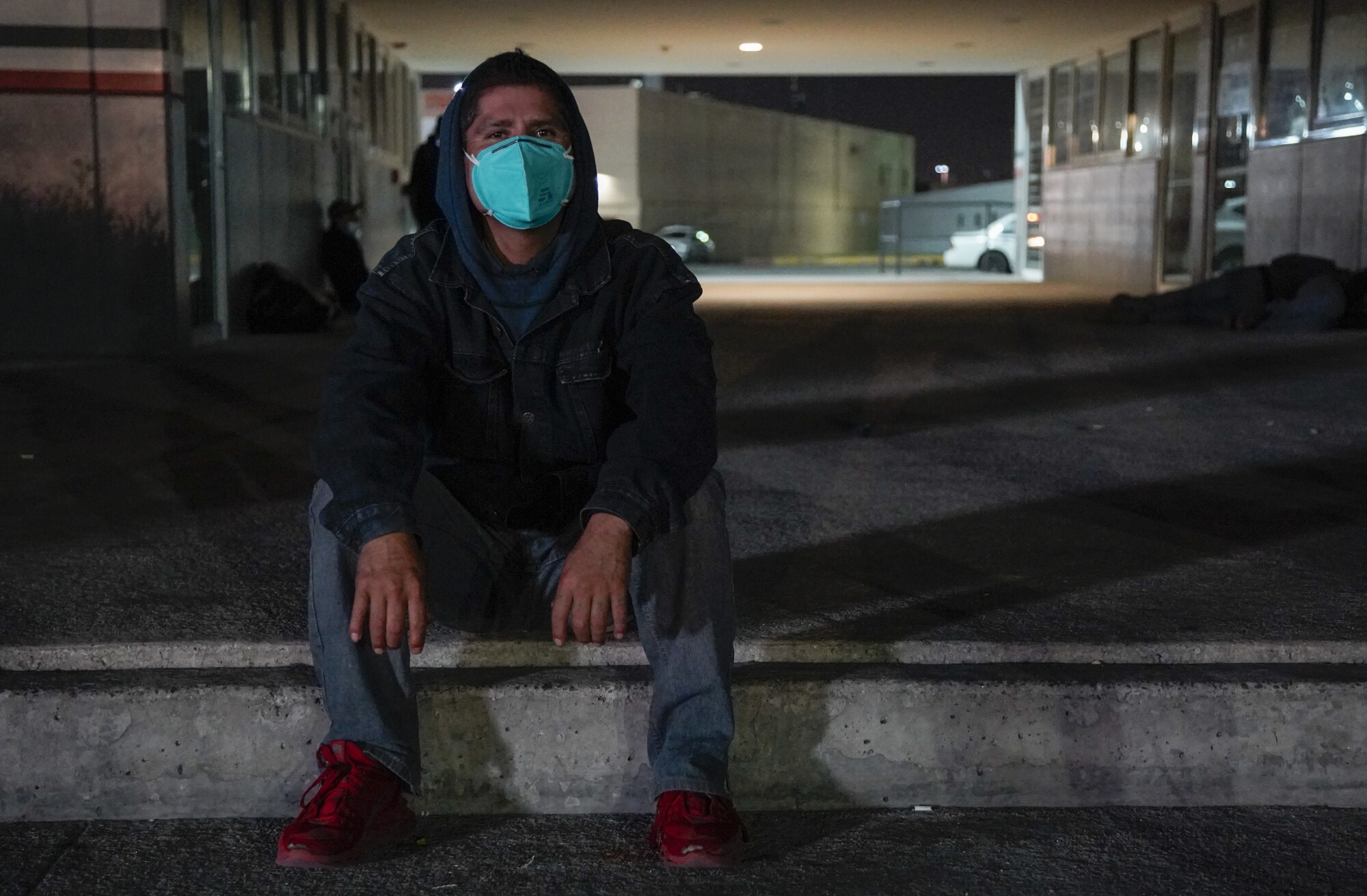
Enrique, who tried several times to enter the U.s.a. earlier he was successful, waits for morning time to leave the surface area around the Otay Mesa Port of Entry.
(Alejandro Tamayo / The San Diego Matrimony-Tribune)
The pandemic's economic repercussions have been felt in the United States and Mexico, only they led to vastly disparate atmospheric condition in the neighboring countries.
In Mexico, jobs have disappeared and not returned. With no support from the government, many Mexicans are struggling to pay hire and other basic bills.
In the The states, when unemployment rose during the pandemic, authorities officials moved to distribute trillions of dollars of relief for workers and businesses. Now, for a combination of reasons, many industries are facing worker shortages.
"In the history of the edge, you lot would say this looks like a lot of other periods where we had a lot of clearing from Mexico, like in the 90s where the economies were moving in two different directions," said Everard Meade, director of the Trans-Edge Institute at University of San Diego. "When you have big gaps in growth in countries that are then intertwined, we should wait to see a scrap of a labor market demand."
The worker shortages in the U.Southward. led one Wisconsin employer in the construction and repair industry to reach out to onetime employee Enrique, a 42-year-sometime man from Puebla who spent several years equally an undocumented worker in the United States before returning to Mexico on his ain to be with his family. The employer begged Enrique — who, like others in this commodity, is not being fully identified considering of his vulnerable situation — to come back to piece of work for the visitor and even offered to pay the smuggling fee.
Hoping to salve plenty coin to build a house for his family so that he wouldn't have to worry nearly hire amidst job instability in his hometown, Enrique agreed. He left his wife and son behind and set out for Tijuana, where he heard that smugglers were good at getting migrants across.
He tried three times to cross near the Las Americas outlets, where a young Guatemalan girl was recently institute left at the border alone by smugglers. Enrique said the smuggling group guiding him distracted Border Patrol agents so that he and other adults could run across and hibernate until the levantón, or person sent to pick up the crossers on the U.Due south. side, showed up. But each time, he was caught and expelled.
If he had fabricated it across, his employer would've paid $viii,000, he said. Only since he didn't make information technology, he didn't have to pay anything.
Then, he tried with a smuggler who planned to pass out fake visas and take a group in a car through port-of-entry vehicle lanes. Success on that route meant a bill of $12,000 at the other end of the journey, Enrique said.
But Tijuana municipal police pulled the car over earlier the group made it to the borderline and arrested many of those in the machine. Enrique found himself alone most the Otay Mesa Port of Entry effectually 4 a.m. and decided to await with the recently expelled until the sun came up and different transit options opened before trekking back to where he was staying in the city.
In the darkness, Tijuana streets tin can be specially dangerous for those who have been expelled. Both criminal organizations and police akin are known for beatings, robberies and worse, and, similar deportees and other migrants, the expelled are oft visibly vulnerable, making them likely targets.
In the daytime, the expelled frequently comport Styrofoam containers of sandwiches given to them while they were being processed for return. Overnight, at that place are no to-go meals — they come back with whatever they carried with them on the journeying north, days or fifty-fifty hours before.
Many choose to sleep in the light of the port of entry plaza in the hopes that they will be safety at that place until morning.
Afterwards his failed attempts, Enrique concluded up waiting a few weeks in a identify where smugglers kept the men who were trying to cross, sleeping on a tile floor in a hallway with at to the lowest degree a dozen others and more in the other rooms.
When he finally fabricated it through without getting caught, it was over the mountains.
Treacherous terrain

To the left of the border fence is Tijuana, Mexico, as seen from Otay Mountain. The debate ends non far from this vantage betoken.
(Alejandro Tamayo / The San Diego Union-Tribune)
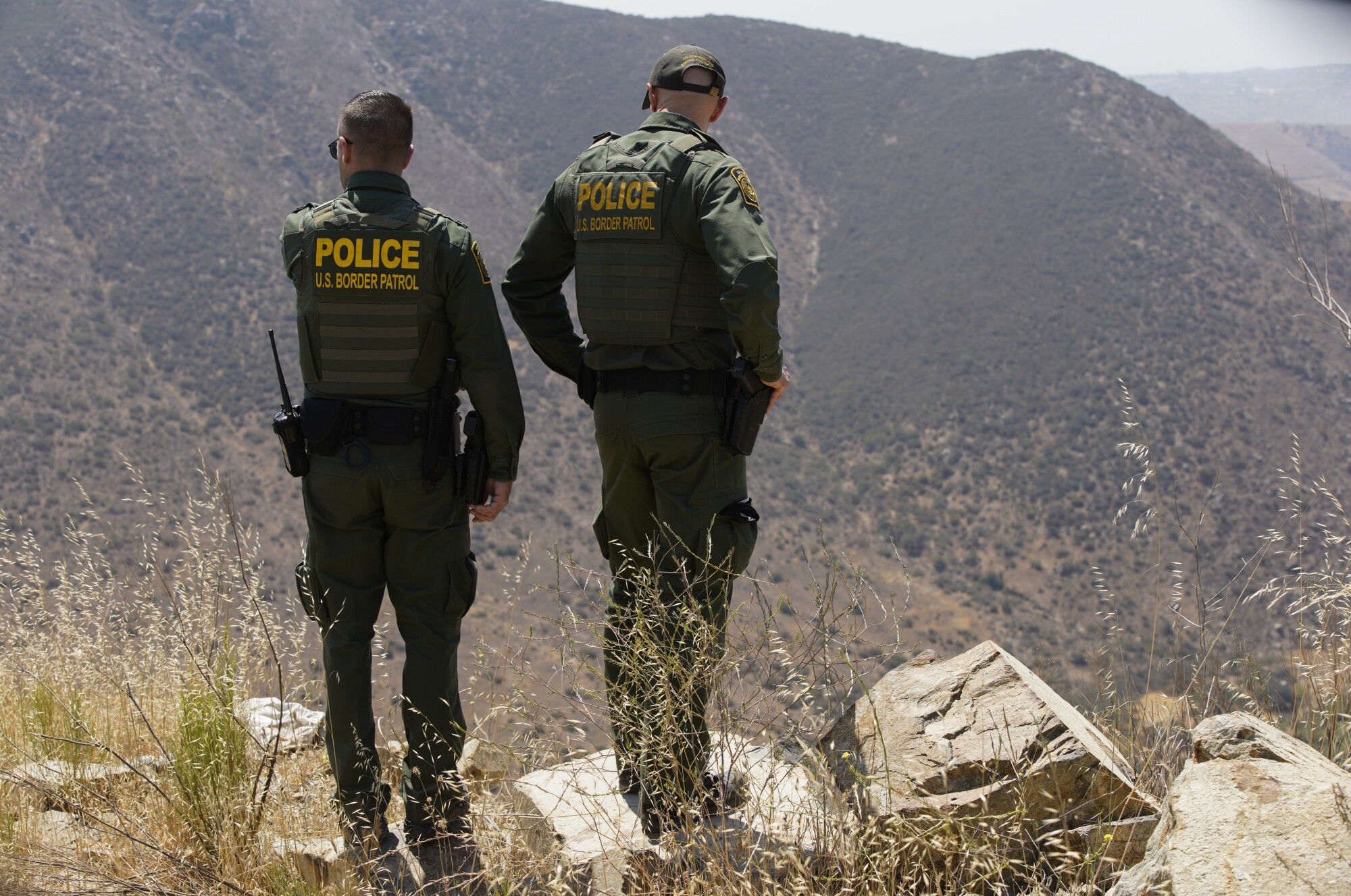
Equally apprehensions have risen over the past year, Otay Mountain — a 3,566-pes tiptop that is home to rattlesnakes, desert brush and off-roading trails — has been ane of the well-nigh popular crossing areas in Border Patrol's San Diego Sector.
Agents oft catch more than 200 people per day on the mountain, Macisaac said.
"We use [Title 42] to the fullest extent that we're able to," Macisaac said, meaning that most of those defenseless on the mountain are chop-chop expelled. "It actually is around the clock."
On a contempo morning, his radio crackled constantly with agents tracking dissimilar groups of migrants as he and young man agent Jeffery Stephenson drove a loop forth the mountain's bumpy and winding dirt route. Other agents reported they were heading to the port of entry to drop off people they'd already caught and processed exterior a nearby station.
Their SUV passed abandoned clothing, h2o bottles and dingy diapers that migrants have discarded along the fashion.
An agent driving the opposite direction along the road rolled up to their vehicle and rolled down the window.
(Alejandro Tamayo / The San Diego Spousal relationship-Tribune)
"Did you run across any bodies?" he asked Macisaac and Stephenson, using Border Patrol's term for migrants. He was looking for two women who had called for aid.
Would-exist crossers oft hike to the mountain from a Mexican highway that runs along the border. Though a few sections of the mount take border barriers erected, much of the border there has no debate at all because of the treacherous terrain.
Smugglers often zigzag abroad from trails and even crawl through the castor to keep from beingness detected, though the vegetation makes the hike that much slower and more than difficult. In the summer, soaring temperatures combined with the strenuous trek can lead to heat exhaustion or worse, and smuggling groups often carelessness migrants who lag behind on the mountain.
"They're misled about what they're getting into," Macisaac said, noting that many looking at Otay Mountain from the south side expect the journey to be much shorter than it actually is.

Francisco, recently expelled, sits near the pedestrian crossing to eat a dejeuner provided past the Mexican officials at the Otay Mesa Port of Entry
(Alejandro Tamayo / The San Diego Union-Tribune)
Francisco, a 23-twelvemonth-quondam man from the land of Guanajuato, was amongst those who gave up on the mountain last month. It was his 3rd time trying to cross the border with his 20-year-quondam brother to join his father in San Jose.
He'd fallen off of the edge wall on a previous attempt, and his legs were already injured. On the mount, he kept falling on steep boulders and banging his legs up even more than. When he realized that he wasn't going to make it all of the style through, he told his brother he was stopping. His brother wanted to stay with him, but Francisco told him to keep moving. The two parted in tears.
"I didn't want to surrender," Francisco said in Castilian. "I said, 'I have to go in that location, I have to get at that place.' I did everything. I gave information technology my all."
After he'd finished crying, Francisco went to notice Border Patrol and turn himself in. A couple of hours later, he was back in the plaza exterior of the Otay Mesa Port of Entry, sandwich in manus, waiting for news from his brother.
His attempt at getting over the mountain was not completely costless. He'd had to pay $500 to pass through an surface area of the edge controlled by a particular criminal organisation. He was going to pay $nine,000 on arrival.
He's waiting at present with a new smuggler who said he can go into the Us with a simulated visa once the border opens to nonessential travel from Mexico.
'Killings every solar day'

Francisco stands in Tijuana near the pedestrian crossing with his clothing dusty after attempting to cross into the Usa over Otay Mount.
(Alejandro Tamayo / The San Diego Marriage-Tribune)
Francisco's motivations for crossing are more layered than Enrique's.
Economics is part of it. His begetter is undocumented and works as a handyman. His father told him and his brother that they could easily get jobs with him and earn enough to save for a house. Francisco, who has a wife and 2-year-old, hopes that will accept the pressure off of his need to find work back home, where long-term jobs that pay plenty to make ends meet are difficult to come past.
During the pandemic, he went an entire month without work, he said, and his male parent had to send him money to help his family unit.
Francisco is likewise worried about the violence in his city, and that is the kickoff reason he gave when asked why he wanted to go north.
"Killings, killings every day," he said.
According to United mexican states's National Statistics Institute, the homicide charge per unit per 100,000 people in the state of Guanajuato rose to 65.1 in 2019, from xx.1 in 2016.
Francisco has seen cartels burn homes near where his family unit lives, and the increasing violence too makes finding steady work even more hard, he said.
In United mexican states, as in many countries in Central America, economic struggles and high levels of violence are interconnected bug that often together influence migration decisions.
In addition to officially recognized homicides, Mexico is likewise grappling with forced disappearances, co-ordinate to Meade, and if those were counted in the homicide rate, it would be considerably higher.
"The murders are but the tip of the iceberg," Meade said.
In recent years, an increasing number of Mexican migrants have sought asylum from the country's violence. But the long-term mentality in the United States that migration from Mexico must be economically motivated, coupled with the difficulty in winning cases where the persecution comes from a criminal organization rather than the government itself, take meant that most Mexicans don't win their asylum cases.
Male parent Patrick Spud, a priest who runs Tijuana migrant shelter Casa Del Migrante, said he's seen an increase in Mexicans arriving at the shelter in contempo months. About are fleeing violence in u.s.a. of Guerrero and Michoacán, he said.
"I'k sure in that location'south a lot of 'Your cousin is here and says now'southward the time,'" Murphy said. "People are and so drastic for hope. Fifty-fifty that little information is enough to move people."

(Alejandro Tamayo / The San Diego Marriage-Tribune)
Among those waiting at Casa Del Migrante is Jonathan Solis, 29, who fled Guerrero with his wife and daughter after he was attacked and extorted.
"The truth is if that hadn't happened to me, I would've stayed in that location," Solis said. "I had two good jobs."
Because they are traveling as a family with their child, the couple accept non tried to cross with a smuggler.
Jose Maria Garcia Lara, director of the Juventud 2000 and Hotel Migrante shelters in Tijuana, said that near of the Mexican asylum seekers he's interacting with are families like Solis'. Juventud 2000 more often than not houses families while Hotel Migrante is meant for adults traveling alone.
Most of the men staying in that location on a recent dark were longtime deportees whose hopes of life in the U.s.a. had go jaded and abandoned.
"United nations sueño americano es inalcanzable," said ane 51-yr-onetime who was deported 20 years ago. An American dream is unreachable.
Migrants become allurement

Maria was repeatedly expelled to Mexico and found herself in danger. She is now an asylum seeker.
(Alejandro Tamayo / The San Diego Wedlock-Tribune)
Maria'southward American dream was meant to be a temporary one — a few years spent working to save up to pay off her land and end building a home for her four children.
But what happened on her migrant journey turned her into an aviary seeker, ane who was in enough imminent danger to qualify for a special exemption to Championship 42 and enter the U.s.a..
Now she may never exist able to render home.
The unmarried female parent admitted she was naive when she set up off with a friend to effort her luck crossing the border. She thought it would be easy, like she had seen in TV shows and movies.
She worked several jobs before the pandemic, simply after COVID-19 emerged, she lost all of them.
"The but thing I desire is to work, to take care of my children, to pay for my country and to requite my children a better future," she said in Spanish. "That's why I'thousand here."
But her friend gave up and went home, leaving her lonely in the edge city. She met a smuggler who took her exterior of Tijuana to a place where she and other migrants were held until the group tried to cantankerous.
Time after time, they failed. Maria began to detect more than about the smugglers — their weapons, their drugs. She realized they were narcotraffickers, and that she and the other migrants were merely allurement to distract border officials while the drugs crossed.
Mayhap, she thought, that's why the levantón never showed up for them.
"I saw and stayed quiet for my safety," she said.
When the smugglers began to ask her to do favors for them, she constitute a way to escape.
"I never thought I would've been involved with narcos," she said. "I had no thought."
Back in Tijuana, she soon received threatening letters from them, and masked men showed up to look for her in places she had previously stayed in the city.
"They told me they were going to kill me, that they knew where I was, that they would impale my children," she said.
Maria went into hiding until an attorney with Immigrant Defenders Law Heart was able to go her case approved for the Championship 42 exemption. Though she'southward now in the United States, she's not yet allowed to work.
She worries about her children, who telephone call her request for money for food. If she'south not able to send coin to continue paying for her country, they will become homeless.
If she wins her asylum case, Maria hopes her children might be able to join her in the Us. With the immigration courtroom backlog at one.3 meg, she will probable not know the outcome of her case for years.
Walled Off: Mexico's role in migration
An occasional serial in which the Los Angeles Times and San Diego Wedlock-Tribune explore United mexican states'southward office in migration and the weather in that land that drive people northward.
Source: https://www.sandiegouniontribune.com/news/immigration/story/2021-07-11/mexican-adult-migrants
0 Response to "I Will Never Go to Tijuana Again"
Post a Comment